The morning view.
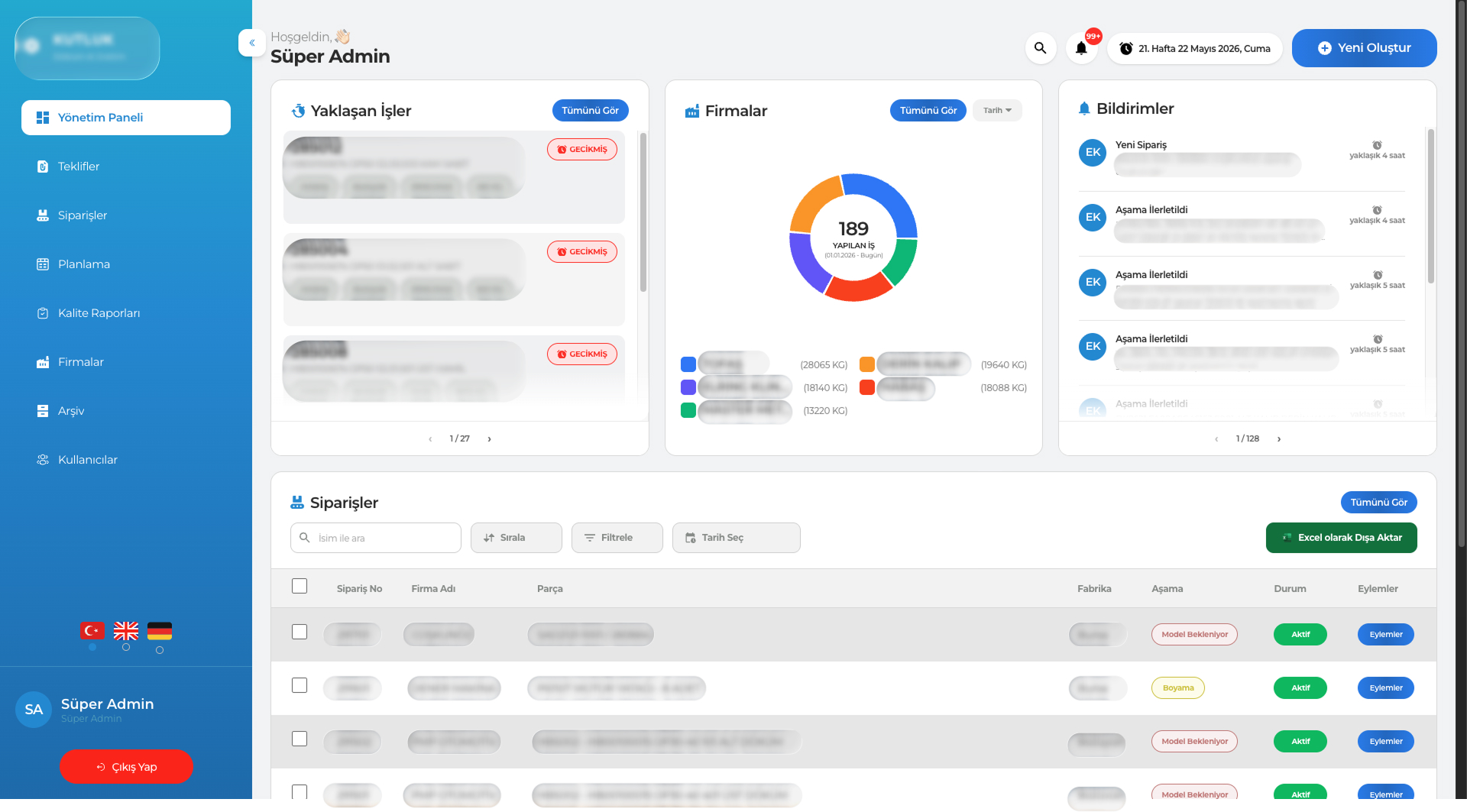
Owners and managers open the platform to a single live screen: upcoming work, overdue flags, company-by-company workload, and the events feed. Three glanceable cards replace a stack of WhatsApp threads.

A purpose-built ERP for a Turkish foundry and casting manufacturer — twelve connected data domains and eighteen functional screens replacing whiteboards, WhatsApp groups and Excel sheets with a single modern operating system for the factory floor.

Turkish manufacturing is a multi-billion-dollar export engine. Yet the average foundry still runs on paper travellers, spreadsheets, and verbal handoffs — and the generic ERPs they're sold don't speak their language.
Turkish manufacturing is a multi-billion-dollar export engine — yet the average foundry still runs on paper travellers, spreadsheets and verbal handoffs. The generic ERPs they're sold (SAP, Logo, Netsis) are either too expensive, too generic, or built for a different era. They model a business that doesn't exist on the shop floor: the foreman doesn't think in 'work order receipts', he thinks in boyama, kalıp, döküm.
Orders get lost between stations, 'where's job 4127?' is answered by phone, defects are tracked in a notebook (if at all), quotes are recalculated by hand for each currency, and the owner has no real-time view of the floor.
Not a prototype, not a deck. Twelve connected data domains across eighteen functional screens — covering quote-to-shipment without leaving the product. Every module is in use today.
EUR, USD, TRY and Gulf-market terms from day one.Model Bekleniyor → Model Alındı → Boyama → Kalıp → Döküm → Temizlik → Sevkiyat.99+ isn't noise — it's gated by role.Super Admin · Admin · Manager · Worker — with per-page permission gating.Every UI surface uses the real vocabulary of a Turkish foundry — not a translation of a SaaS template. The team speaks boyama, the software speaks boyama.
Owners and managers open the platform to a single live screen: upcoming work, overdue flags, company-by-company workload, and the events feed. Three glanceable cards replace a stack of WhatsApp threads.

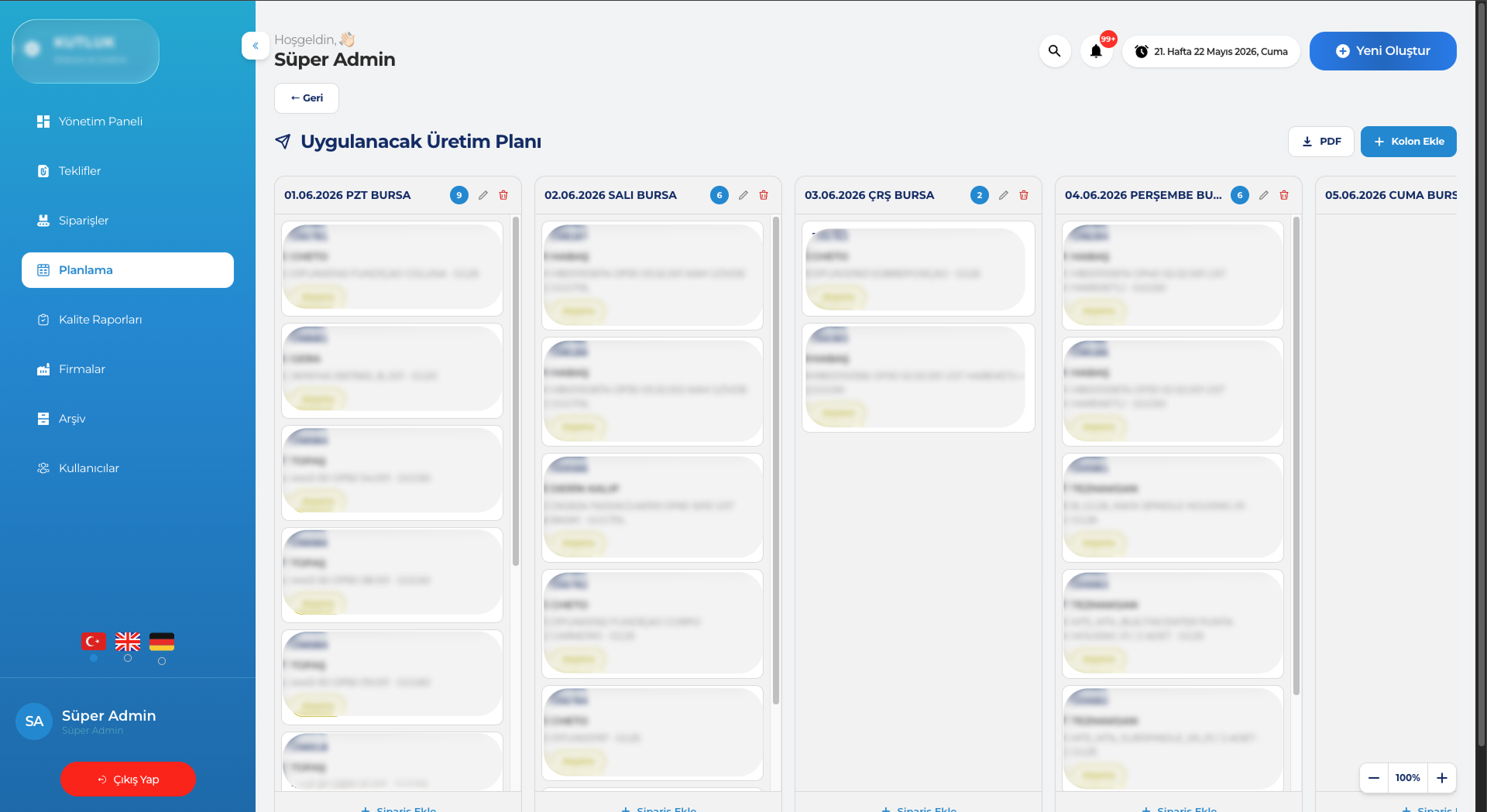
A kanban board sized for foundry reality: columns are days, cards are orders, and the floor manager schedules by sight. New column, new shift — done.

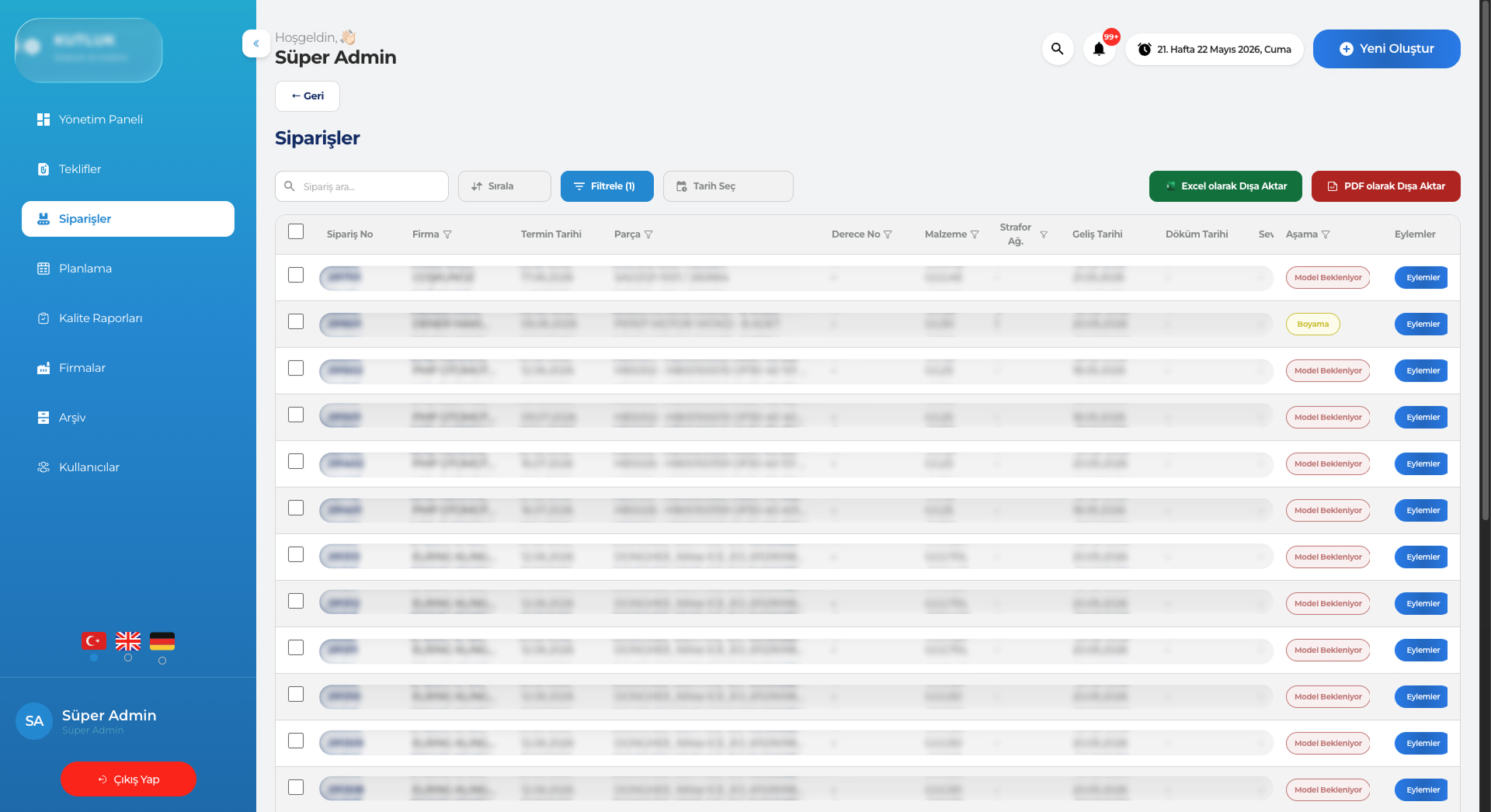
One table, twelve filters, a date picker, and inline-status. Every order shows its current stage as a coloured pill — Boyama, Model Bekleniyor, Aktif — so the foreman doesn't need to open the row to know.

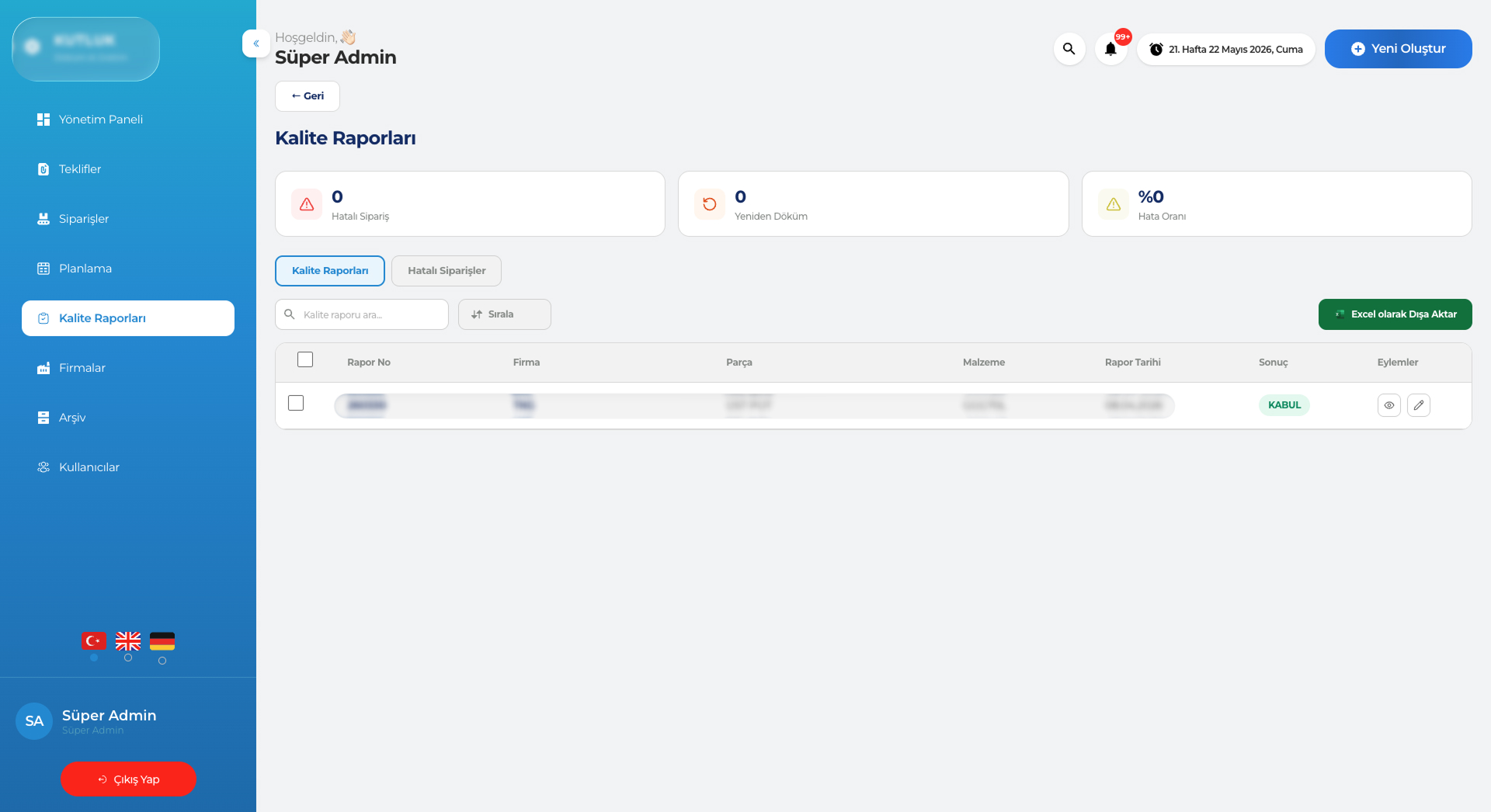
Quality reports live next to the order, not in a notebook. Defective count, re-casting count, error rate — surfaced at the top so the owner sees the number before anyone has time to massage it.

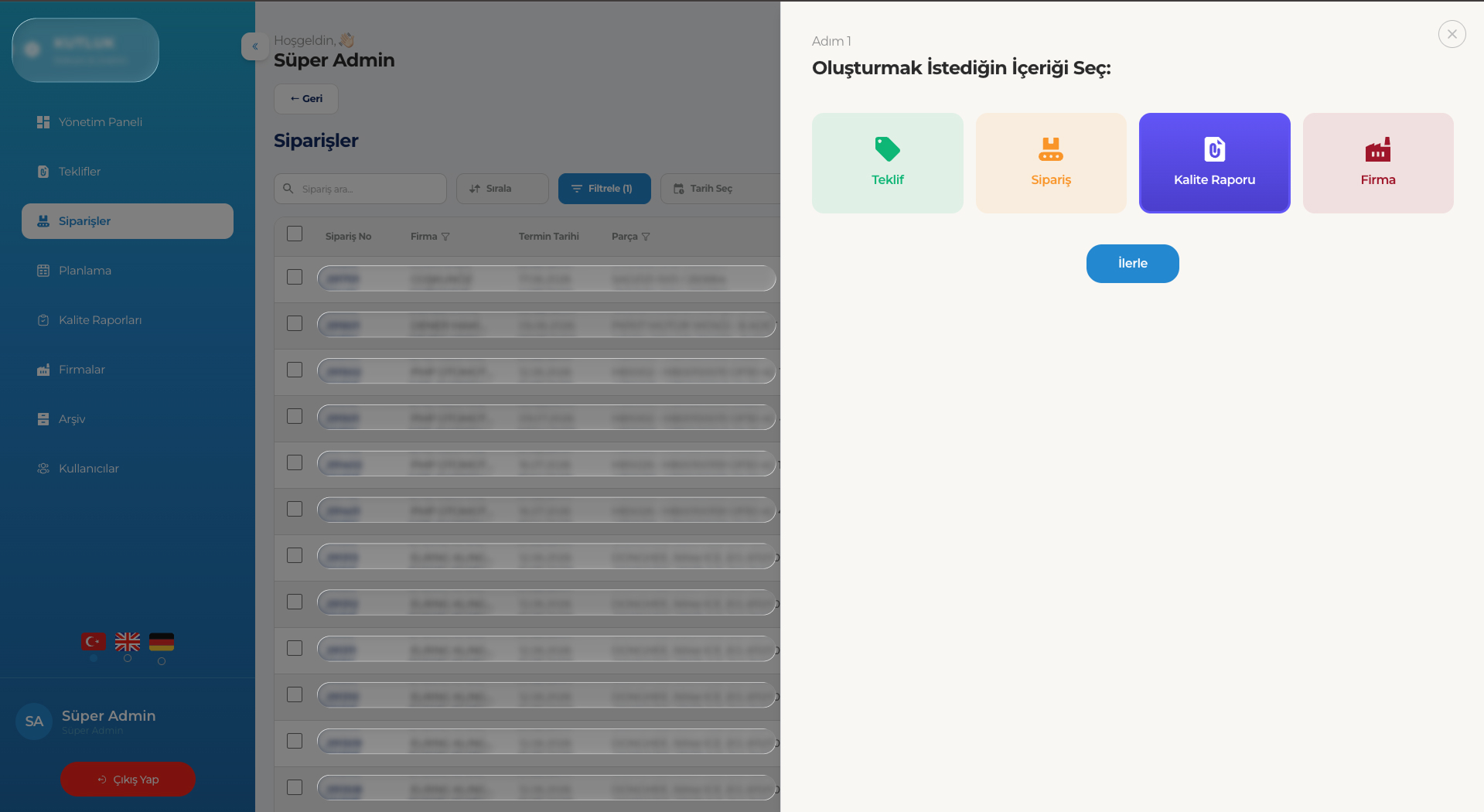
A single "Yeni Oluştur" affordance steps the user through Teklif → Sipariş → Kalite Raporu → Firma. The schema is opinionated; the user experience is not.

Six reasons the platform beats a generic ERP and a templated SaaS — on a Turkish foundry's actual workday.
Every screen uses the words a Turkish foundry already uses. The owner doesn't learn a new dialect — the software learned theirs.
The same stack Vercel, Linear and modern SaaS leaders ship on. Recruiting against it is easy. Scaling it is cheap. Iteration speed is multiples faster than legacy ERP.
The repo contains dated customer-feedback files with numbered items being closed week by week. Currency-aware line items, PDF flows, UX refinements — all shipped in response to real operators. We don't guess what customers want. We ship what they tell us.
Turkish UI. Click-to-edit forms. Minimal-friction workflows. Role-gated pages. Built around what a foreman, an estimator, and an owner each need on their own screen — not a one-size-fits-nobody dashboard.
Quotes and orders support multiple currencies on day one. Turkish foundries serve European OEMs in EUR, US buyers in USD, and Gulf customers in their own terms. The platform handles it.
Anyone can build "a CRM." Almost nobody understands the 7 stages between a wax model and a shipped casting. We do — and the database knows it. Once a foundry's history lives in the platform, switching cost approaches infinity.
A short list of tense statements — present, not future. Nothing on this page is a roadmap.
Twelve domains, eighteen screens, four role tiers — covering quote-to-shipment without leaving the platform. Live with the operator team today.
Numbered, dated feedback closed week-by-week. Currency-aware line items, PDF flows and UX refinements all shipped in response to factory operators.
Type-checked end-to-end, modular, ready to scale to multi-tenant SaaS. The same shape every modern team would build it again today.
Backend, frontend and database designed for cloud hosting from day one — server-rendered, edge-friendly, mobile-responsive.

Turkish manufacturing runs the country's exports — but it still runs on whiteboards. This is the operating system for that industry. Already built. Already in operators' hands.
Tell us about the problem you're trying to solve. We'll write back within one business day.